
There was a time, not too long ago, when U.S. and allied troops could take for granted they’d be able to communicate. Sure, an enemy might engage them in firefights, ambush them with roadside bombs, or even attack with tanks, artillery, and air power. But there were few foes who could challenge the Americans and their friends in the electromagnetic spectrum. U.S. and allied troops could coordinate with each other and with distant headquarters, overhead aircraft, and even far-flung warships – all at their leisure.
Those days are over. Russia’s wider war on Ukraine should make it obvious: the EM spectrum is no longer a safe haven for Western powers. Not only can the most serious foes (e.g., Russia, China, etc.) contest the spectrum with jamming and other forms of electronic warfare, but they can also do so with such intensity that no single mode of communication is secure and reliable. Every front-line unit and every major weapon system will need redundant comms.
The Ukrainians learned this the hard way. Leaning heavily into robotic systems to alleviate a deepening manpower shortage, the Ukrainian armed forces established the world’s first independent drone branch, the Unmanned Systems Forces, in 2024. Developing new sea, ground, and aerial robots at a breakneck pace and deploying them by the tens of thousands, the Ukrainians have elevated robotic warfare from a supporting function to a core component of their million-person military.
But a robot, even a highly autonomous one, is only as good as its comms. As recently as 2022, Ukrainian operators could rely on line-of-sight radio or a commercial satellite communications service (Starlink is the current favorite) to connect their unmanned vehicles on the water, on the ground, or in the air.
The Russians jammed everything. “Electronic warfare is an exceedingly important part of modern operations, and the Russians have had a significant advantage in it throughout the war, which has proved a sustained problem for Ukraine,” Jack Watling, a senior research fellow at the Royal United Service Institute in London, told The Financial Times in 2024.
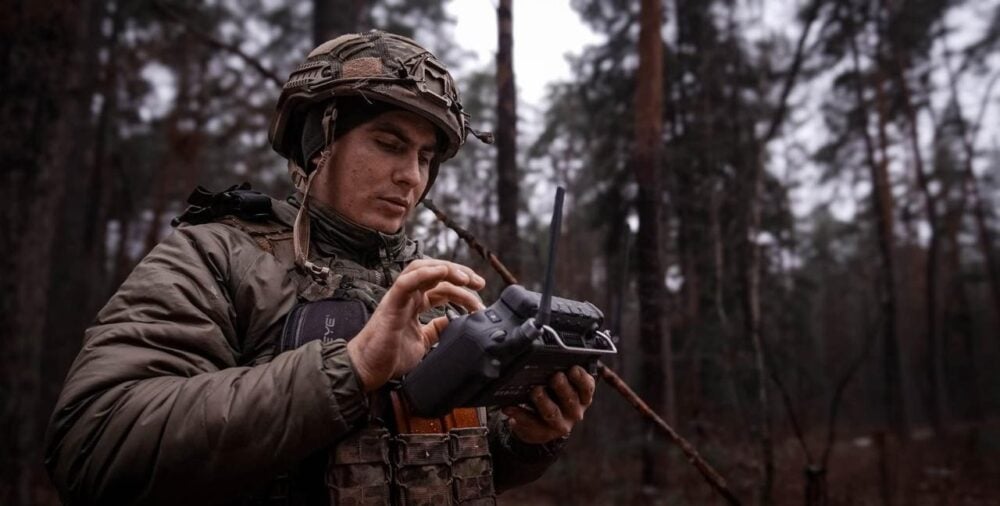
Yes, tech developers can stay ahead of traditional radio jamming by adding more antennae to their communications systems, frequently switching frequencies, and programming their comms to ignore the strongest signals (which are often jamming). But the enemy still gets a vote. Rival tech developers can add emitters and switch up their own frequencies.
The Ukrainians discovered that overlapping comms are key. Every system needs a backup. And the backup needs backups, too.
Consider one new class of unmanned ground vehicle that’s quickly becoming standard in Ukrainian brigades: the evacuation ’bot. It’s no longer safe for human medics to fetch wounded troops off the front line. So brigades send robots, instead.
Essentially armored coffins on wheels, the UGVs roll out to front-line fighting positions, load up a casualty, and then roll back to the nearest field hospital. The standard evacuation ’bot is steered by a remote operator seeing what the vehicle sees through its front-mounted camera, and that’s the UGV’s greatest weakness.
The standard Starlink connection “is often unreliable under trees or jamming,” Ukrainian-American war correspondent David Kirichenko explained after visiting a Ukrainian brigade. To give an evacuation ’bot and its precious human cargo the best odds of survival, the Ukrainians install “a patchwork of comms,” Kirichenko wrote.
They include: radio mesh networks, which use multiple routers on various UAVs and UGVs to create a single, unified wireless network with fewer dead zones; wireless bridges and relays, where one robot (in the air or on the ground) relays signals to and from another, more distant robot; and, as the final backstop, miles-long fiber-optic cables that may be prone to breaking but have the benefit of being unjammable.
“Each UGV has up to 16 connection points to stay linked,” Kirichenko explained. Those 16 connections dramatically illustrate the sheer scale and intensity of the electronic warfare that U.S. and allied forces should expect in the next major conflict.
Everyone should expect to fight for their comms and fight harder than ever.